 Born in controversy, the Broadway Bridge has proved its worth and served the dreams of its early proponents, who would be amazed at the volume of traffic now crossing the bridge -- some 25,000 vehicles daily.
Doubters said the bridge wasn’t needed because most of the area’s industry and businesses were in eastern sections of Little Rock and North Little Rock. They insisted on building only a new Main Street Bridge. The older bridge at Main, known as the free bridge, built in 1897, was falling down and required constant emergency maintenance.
But Justin Matthews and others argued for the economy of constructing two new bridges, one at Broadway and the other at Main. In 1917, two separate improvement districts were formed, each about 36 square miles that included the two cities and a large portion of Pulaski County.
The Main Street Bridge and Broadway Bridge districts remained at odds until a compromise in early 1919 resulted in the formation of the Broadway - Main Street Bridge District, which Governor Charles Brough signed into law on Feb. 5, 1919, as Act 49.
The new single district covered 72 square miles with an assessed value of $2,914,566.83 in Little Rock, North Little Rock and Pulaski County. The annual overall income from real and personal property taxes in the years 1921-46 was $174,874 for costs associated with construction, maintenance and other expenses of both bridges.
Bridge commissioners contracted with the Missouri Valley Bridge and Iron Company to build both the Broadway and Main Street bridges.
It was still rough going, however, for supporters of the Broadway Bridge.
Even after work had begun, the commission asked Little Rock bankers for a loan of $400,000 in May 1921, because it had been unable to sell a bond issue authorized by Act 49. Some bankers balked at making the loan. It took the influence of former Gov. George Donaghey, the commission’s chairman, who initially opposed building two bridges, to prevail on the district’s need for the money to continue construction.
“To stop work now on both bridges because some people want but one would be simply to stop work without stopping the collection of taxes,” he told the bankers, according to theArkansas Gazette on May 20, 1921.
The tax revenue, if not the bonds, would provide repayment of the loan, Donaghey assured.
“Figure it any way we may,” Donaghey continued, “it will be most profitable to go ahead with construction of both bridges under the law, and with practically the whole county paying the bill.”
The fight wasn’t over yet.
In June 1921 Pulaski County Judge Charles E. Moyer claimed the two bridges would cost $2 million each, and advised a Grand Jury that the public interest demanded building only one bridge.
“Surely by concentrating on one, it could be built more quickly than two,” Moyer contended, according to the Gazette on June 10, 1921. “It could also be financed much more easily and I understand they are having financial troubles now.”
Moyer’s cost estimates were disputed by Fred W. Allsopp, a commissioner. He said, “no estimate that has been made by competent engineers or bridge builders has placed the figures as high as Judge Moyer.” Allsopp also said stopping work would lead to lawsuits, “and would render it impossible to build either bridge” until the next legislature met in 1923.
Although the Grand Jury sided with Moyer, none of its recommendations were followed, including one to remove Justin Matthews and one other person from the commission.
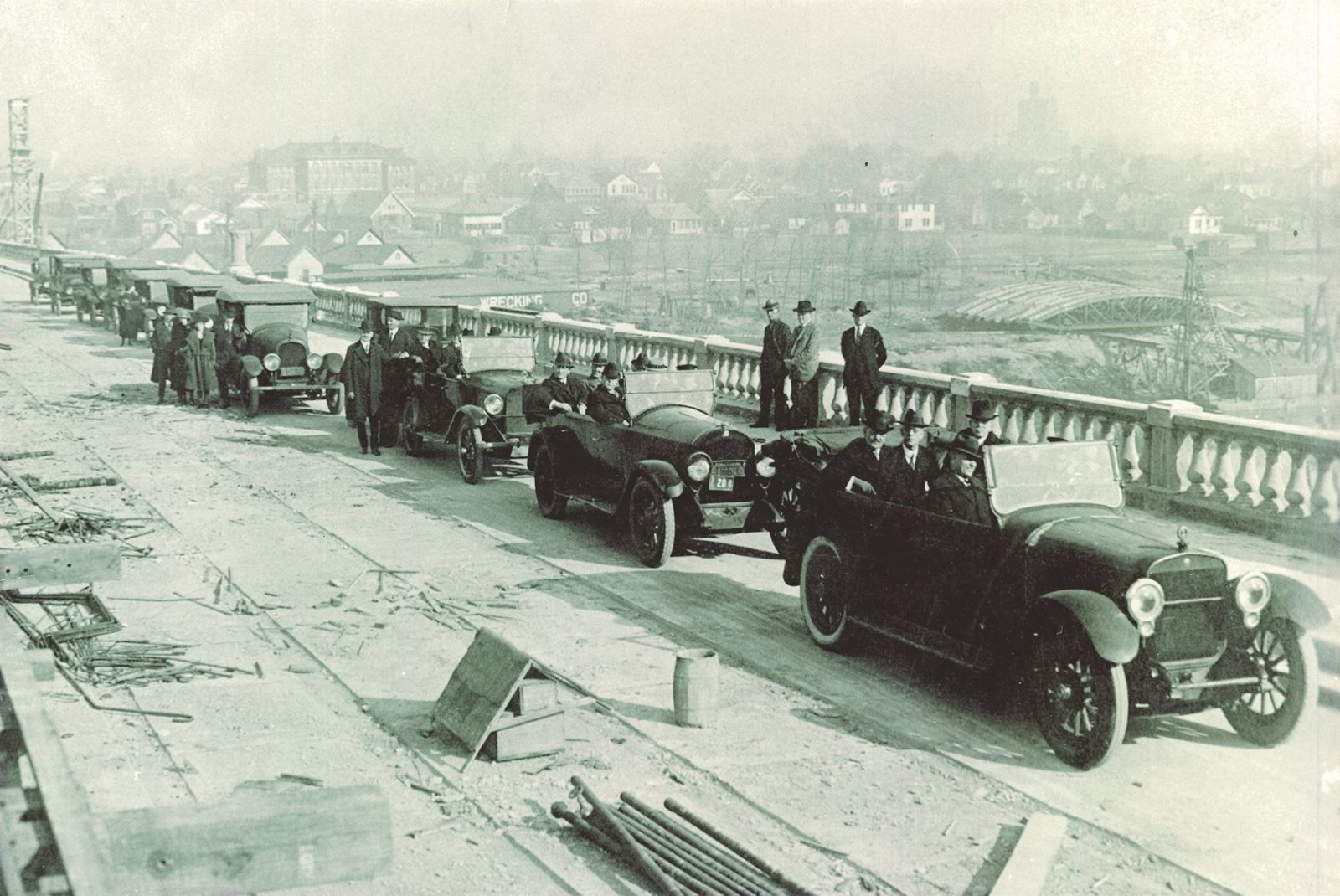
By Christmas Day 1922 the bridge was nearly complete. Though not fully finished, commissioners and other district officials, followed by 10 “unofficial” vehicles, crossed the Broadway Bridge for the first time.
Incandescent globe lights were installed on the bridge just before it officially opened with the dedication on March 14, 1923. Mercury vapor lights were introduced 37 years later in 1960.
Demolition of the free bridge at Main began the day of the dedication of the Broadway Bridge, and a new Main Street Bridge opened the next year.
Over the years, the Broadway Bridge closed temporarily only a couple of times. It shut down for two days after the Merchants Transfer and Storage Company warehouse under the north end of the bridge caught fire on Feb. 9, 1947. Some of the worst traffic jams occurred over those two days.
By the late 1940s and 1950s interest grew in building a third bridge, as all it took was a traffic accident on one of the two bridges to bring gridlock during rush hour. The Interstate 30 bridge was built in 1961.
The Broadway Bridge closed again in 1971 and reopened in early 1973 to facilitate the McClellan-Kerr navigation project. Martin K. Eby Construction Company replaced two original concrete arch spans with a steel through arch span wide enough for barges to pass under the bridge.
After the Broadway Bridge reopened, the old Main Street Bridge built in 1924 was demolished in April 1973. The new Main Street Bridge, constructed by the Eby Company beside the old bridge until it was blown up, opened in October 1973.
Having stood for more than 93 years, the Broadway Bridge is scheduled for demolition this year.
North Little Rock History Commission